
The Elon Musk Mars mission date is one of the most anticipated milestones in space exploration. With his visionary leadership at SpaceX, Musk has set an ambitious timeline to establish a human presence on Mars. But when exactly will this historic journey take place? This article delves into the current timelines, technological developments, and potential challenges that could influence the mission’s date.
SpaceX’s timeline for Mars: The early ambitions
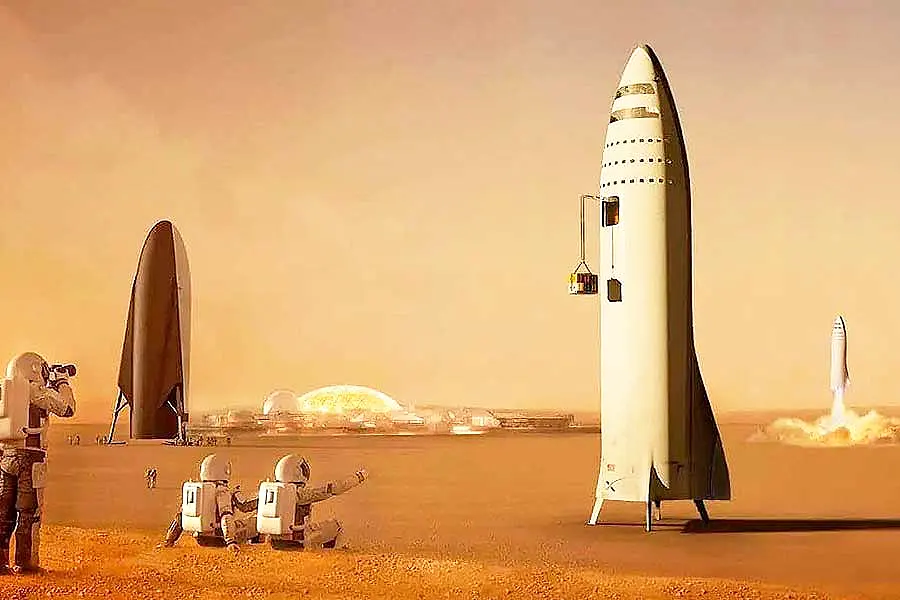
Since the founding of SpaceX in 2002, Elon Musk has consistently emphasized his goal of making life multi-planetary. His vision for Mars colonization is at the heart of this mission. In 2016, during the International Astronautical Congress, Musk unveiled the Interplanetary Transport System (ITS), later known as Starship, a fully reusable spacecraft designed to carry up to 100 passengers to Mars.
Initially, Musk was optimistic about launching the first crewed mission to Mars by the mid-2020s. In subsequent years, this timeline has been refined as SpaceX progresses in the development of Starship. The latest estimates from Musk suggest that a crewed mission could take place as early as 2029, with cargo missions potentially launching a few years earlier.
Current status of Starship development
The Starship spacecraft is central to Musk’s Mars mission. Designed to be a fully reusable system, Starship consists of two stages: the Super Heavy booster and the Starship spacecraft itself. This combination is intended to reduce the cost of space travel significantly and allow for large-scale missions to Mars.
As of 2024, SpaceX has made significant progress in Starship’s development. The company has conducted several test flights, including high-altitude tests and successful landing attempts. However, the road to Mars is not without challenges. Regulatory hurdles, technical setbacks, and the need for further testing and iteration mean that the final version of Starship is still a work in progress. Despite these challenges, SpaceX remains committed to conducting the first orbital flight of Starship soon, a critical milestone on the path to the Elon Musk Mars mission date.
Key milestones leading to the Mars mission
Several key milestones need to be achieved before the Elon Musk Mars mission date can be set with confidence:
- Orbital flight tests: The first orbital test flight of Starship is crucial. This test will demonstrate the spacecraft’s ability to reach orbit and return safely. A successful orbital flight will pave the way for more advanced missions, including cargo deliveries to space and lunar missions under NASA’s Artemis program.
- Lunar missions: SpaceX has been selected by NASA to develop a version of Starship for the Artemis program, which aims to return humans to the Moon by 2025. Success in these lunar missions will not only prove Starship’s capabilities but also serve as a testing ground for technologies that will be used for the Mars mission.
- Cargo missions to Mars: Before humans can land on Mars, SpaceX plans to send cargo missions to deliver essential supplies, infrastructure, and potentially autonomous systems that will prepare the landing site for human arrival. These missions could begin in the mid-2020s, setting the stage for crewed missions by the end of the decade.
- Crewed missions: The ultimate goal is to send the first humans to Mars. According to Musk’s latest estimates, the first crewed mission could take place around 2029. This mission will be the culmination of years of development, testing, and incremental advancements in space exploration technology.
Challenges ahead: What could delay the mission?
While SpaceX is making rapid progress, several factors could impact the Elon Musk Mars mission date:
- Technical challenges: Developing a spacecraft capable of safely transporting humans to Mars and back is a monumental task. Even with SpaceX’s impressive track record, unexpected technical issues could arise, necessitating redesigns or additional testing.
- Regulatory approvals: SpaceX must navigate complex regulatory environments, including obtaining launch licenses, environmental clearances, and international agreements. Delays in securing these approvals could push back the mission timeline.
- Funding and resources: Although SpaceX is a private company with substantial resources, a mission to Mars will require significant investment. Securing adequate funding, whether through private investors, partnerships, or government contracts, will be essential to maintaining the timeline.
- Human factors: Preparing astronauts for a mission to Mars involves extensive training and addressing the psychological and physical challenges of long-duration space travel. Ensuring the safety and well-being of the crew could influence the timing of the mission.
Conclusion: What to expect for the Elon Musk Mars mission date
The Elon Musk Mars mission date is not set in stone, but significant strides are being made toward achieving this historic goal. As of now, the earliest realistic date for a crewed mission to Mars appears to be 2029, with the possibility of cargo missions taking place earlier in the decade. However, numerous factors, both technical and logistical, could influence this timeline.
One thing is certain: Elon Musk and SpaceX are relentlessly pursuing the dream of making life multi-planetary. While there are challenges ahead, the progress made thus far suggests that humanity’s first steps on Mars are within reach, potentially within this decade.
As we approach the Elon Musk Mars mission date, the world will be watching closely, ready to witness the dawn of a new era in space exploration.